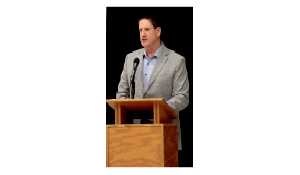
Grant Jackson reflects on his first year in federal politics
January 12, 2026, 5:23 pm
Nicole Taylor, Local Journalism Initiative Reporter


The World-Spectator reached out to Brandon-Souris MP Grant Jackson for his take on 2025, and his thoughts on what 2026 may hold. Following are his comments.
What were some of the highlights of 2025 for you?
2025 was a pretty big year, being my first federal election, getting elected, and certainly the level of support I got from the folks of Westman was amazing. It’s been humbling, and a pretty profound responsibility. That was a pretty big highlight for 2025, it’s hard to top that.
I think we’ve done some important work as the official opposition since we’ve been here. Since the election we’ve got a number of private member’s bills on the floor that certainly aren’t through the legislative process yet, but I’m glad we’re taking them forward. It’s standing up for our region, the Prairies. Too often I find they are are forgotten about in the halls of Ottawa and Toronto, so it’s important that we continue to raise our voices here in Canada. It’s been a big year.
What surprised you the most about moving from provincial to federal politics?
I guess the scale of the needs in this country for government to work better, and to solve problems. Every week there’s dozens of groups and organizations that have challenges with some faction of the federal government, some department, or existing law that must be changed because it is impacting something not in a positive way. That has certainly been one of the main things, the scale of the task ahead of us. That just makes you get up earlier the next morning and work a little bit harder.
What are some things you’ve accomplished in 2025?
I’m working through a couple of PMB ideas that aren’t all the way through the consultation process, those likely have no hope of passing because of the low number I drew in the order. However, it’s also an opportunity to raise awareness for an issue so that perhaps may be picked up in the future by somebody else, or at least you can create public awareness or get information on the issue.
I think some of the big accomplishments we’ve had as a team is holding the Carney government to account. People thought his honeymoon was going to be long and I see that coming to an end very quickly. He is certainly being faced with some of the comments he made previously where he raised the expectations of Canadians and he is failing to deliver on those. I think we’ve done a great job as a team in making sure that he is held to account. When you make commitments to Canadians, you have to deliver on them, and he is not doing that. These are some of the things I’ve been working on. “Accomplished” isn’t something I really think about often. I think there’s just so much to do, and there’s no shortage of what needs to be worked on further.
What were some disappointing things in 2025 for you?
Of course the national election results for one, but we had a very strong showing in the proportional vote. Some disappointments maybe were that Carney had deviated significantly from what he had committed to in the campaign. He billed himself as the guy who was going to get a deal with the Americans, and we all want a deal with the Americans. The uncertainty of the situation as it currently exists is not sustainable. It’s terrible for business, it’s terrible for job creation, so that’s a huge disappointment, that he has been unable to achieve a deal as he promised.
On the spending side too, the whole line we heard from him is that he was going to spend less to invest more. I don’t know how a $78 billion deficit is spending less, and I don’t think most Canadians do either. That’s been a big disappointment because that’s going on the backs of younger Canadians who are going to have to pay this back someday, or continue to have their tax money go toward interest payments when it should be being going towards healthcare, roads, job creation, defence, and many other things.
What were some of the things that happened in 2025 that had the most effect on your constituents?
Inflation continues to be a problem, I think affordability whether it’s home building, rent rates, putting food on the table, those numbers aren’t coming down. Canada is a very wealthy country, there is no reason that well educated people coming out of our school systems with good jobs should be choosing between their hydro bill and their grocery bill. It’s unacceptable in a G7 country, and it’s getting worse. I would say that’s the single biggest thing but there’s lots of things.
There’s canola tariffs, the oil and gas situation for our region, there’s lots of things that are affecting my constituents, like crime and safety, but I think affordablility is the biggest one.
What’s one of the most common things you here from your constituents?
The affordability, as well as the crime and safety piece for sure. There’s just no question that people are totally fed up with how our court system is working in this country. It’s totally unacceptable, and they’ve had enough. We introduced a bill at one point, then the Liberals introduced one about a month later that was a watered-down version of ours, slowly making its way through the legislative process. We don’t think it goes far enough, we don’t think that it’s going to have the impact that people are calling for.
Looking ahead to the new year, what would you like to see worked on in 2026?
For starters we need a couple of trade deals, we need a recess for our canola growers and our pulse growers with China and India. That last one continues to be a big challenge and in my work, on the Procedure and House Affairs Committee, we deal with elections and foreign interference in our elections and we know China is mucking around in that too. We need to deal with the Chinese not just for agricultural products, but for respecting Canadian democracy. I would like to see a reset in the relationship between those two countries and obviously the United States as well.
We know that CUSMA expires in 2026, and it’s up for renewal, so we need a deal. Free trade should remain in this continent. It’s been the single most profound economic growth creator in world history, and I strongly agree with free trade. The Americans need to be reminded about how much they benefit from free trade as well. Those are my top couple of things that I really want to see addressed in 2026.
What will be some challenges for your party in 2026?
We’re not in government obviously, so there’s always a challenge there. You get frustrated because you’re not able to implement government spending changes, or public policy discussion. I think the party needs to continue to engage with the grass roots. We’ve got a convention in January that will kick 2026 off in a good way, and we need to keep that level of engagement up and continue to reach out a broaden our voter coalition.
We need to broaden that further and we need to undertake that work. That’s a lot of travel, it’s a lot of engaging with people on their doorsteps, meeting people face-to-face at events, but that is by far the most effective way to do it.
I know as a team we all have to take on some of that work, the leader can’t do it alone, it has to be a team approach. It’s a challenge but it’s an opportunity as well.
What do you want to see accomplished by the next election?
We have established the narrative that on certain measures that the Liberals have put in place over the last 10 years that have hurt this country by hurting affordability. The Carbon Tax, the emissions cap on the oil and gas sector, the badly bungled international relationship with major trading parteners. If we can continue to keep those issues at the forefront, maybe we can get the Liberals to admit they’ve made some mistakes and even reverse course on some of these things.
I think those are important things that we can accomplish, and I think we have to remind all Canadians that the only reason change happened on those fronts is because the Conservative Party was standing up for them, and their values and beliefs.
What is most challenging about being an MP?
Certainly the travel, which has been a lot to get used to, especially with the flight situation in this country. Just trying to make that time productive when you’re in transit can be tough.
But I think making sure you’re being access able as possible to everyone you can is both an opportunity and a challenge, because it’s such a large area with thousands of people. I feel that I want to be at so many things, but it’s impossible to be in 10 places at once. We’re trying our best to be as present and engaged as possible while also doing the job that I was elected to do here.
What is the most rewarding thing about being an MP?
The individual case work is actually some of the most rewarding. Some people have these big, grand visions of what you do as an MP on the floor of the House of Commons, but I think the most rewarding thing is when you help someone with an issue. Whether it’s in immigration, whether it’s in veterans’ benefits, old-age security, or disability, and for some reason, some sections of government were not giving them what they were owed and what they needed to get by.
The impact an MP can make with help from their office team, I’ll give them a lot of credit, they are on the front line there, but some of the emotional letters, cards, or phone calls I get thanking me or whatever it might be, I think that is certainly the most rewarding part.